Venomous blue dragon sea slugs spotted on Muizenberg beach
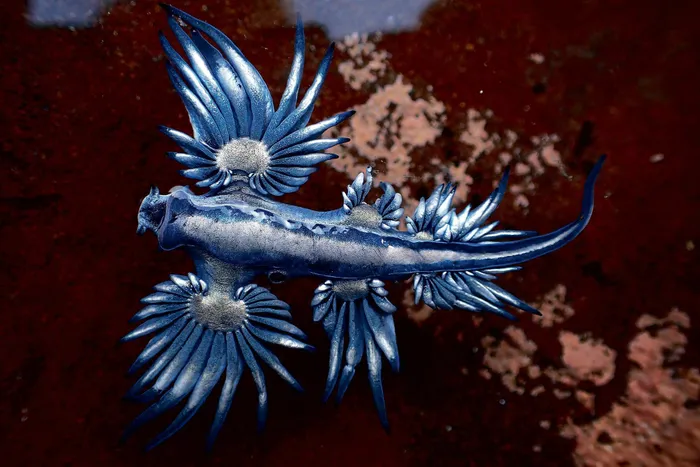
The blue dragon sea slug, Glaucus atlanticus, was recently spotted on Muizenberg beach.
Image: Sea Change Project
Beachgoers are being urged to exercise caution after several blue dragon sea slugs were reported washed up on Muizenberg beach this week.
The tiny marine animals, formally known as Glaucus atlanticus, are rarely seen ashore but can be carried in by winds and currents.
Although striking in appearance, they are capable of delivering a painful sting.
Heather Wares, communications manager at the Two Oceans Aquarium, said strandings of blue dragons are unusual but not unprecedented.
“The blue dragon slugs seen washed up on Cape Town’s beaches are an unusual sight. This stranding event is an uncommon occurrence but is known to happen globally from time to time, often together with blue bottles,” Ms Wares said.
She added that while caution is necessary, the animals also offer an opportunity to learn about marine life.
“While beachgoers should be aware of the risks associated with being stung by one of these highly venomous nudibranchs, this is also an opportunity to learn about these extraordinary marine animals,” Ms Wares said.
She added that, apart from being beautiful, blue dragons hold biological significance. Their ability to incorporate another species’ defence mechanism into their own is an extraordinary evolutionary adaptation, capturing the imagination while demonstrating the complexity of marine life.
Blue dragons are small - rarely exceeding 3cm in length - and have vivid blue and white colouring. They float upside down at the ocean’s surface, drifting with currents.
They feed on venomous creatures such as Portuguese man-o’-war, commonly known as blue bottles, and are able to store their prey’s stinging cells for defence. This means they can still sting even after they have died.
Ms Wares urged visitors to follow safety protocols while appreciating the animals’ unusual biology.
“We urge the public to follow safety protocols, while appreciating a sense of wonder that the blue dragon slug inspires, encouraging a respect for the natural world in Cape Town’s urban setting,” she said.
Health guidance shared with the alert advises that a sting may cause sudden, intense pain, skin inflammation, swelling and raised welts, as well as nausea and vomiting.
If stung:
Rinse the affected area with seawater only to remove any remaining stinging cells. Fresh water should not be used.
Apply heat by immersing the area in hot water - about 45°C, or as warm as tolerable - for 20 to 90 minutes to help reduce pain.
Seek medical help if symptoms worsen, become severe, or if there are signs of an allergic reaction.
Beach visitors are advised not to touch the animals if they encounter them on the sand, and to alert others nearby, especially children, who may be drawn to their bright colouring.
Find the False Bay Echo on TikTok and Instagram @ccmonlineza